



|
Getting your Trinity Audio player ready...
|
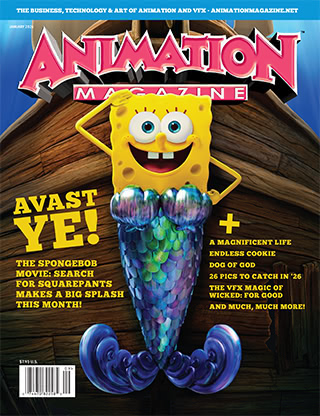
This article was written for the
January ’26 issue of Animation Magazine (No. 355). |
Few animated documentaries dig into family history with the mix of candor and surrealism driving Endless Cookie. Directed by half-brothers Seth and Pete Scriver — one white and one Indigenous — the film assembles years of conversations, memories and real-life interruptions into a family portrait that’s both intimate and unexpectedly expansive. Their approach to animated nonfiction is loose, associative and deliberately handmade, a style that mirrors the humor, identity and creative friction that shape their lives between Toronto’s bustling Kensington Market and the remote Shamattawa First Nation in Northern Manitoba.
Premiered at Sundance in January, Endless Cookie has had a remarkable festival run — picking up awards at Sitges, Leipzig and Annecy — and arrives in New York and Los Angeles theaters via Obscured Releasing on Friday, December 5.
Kitchen Table Stories
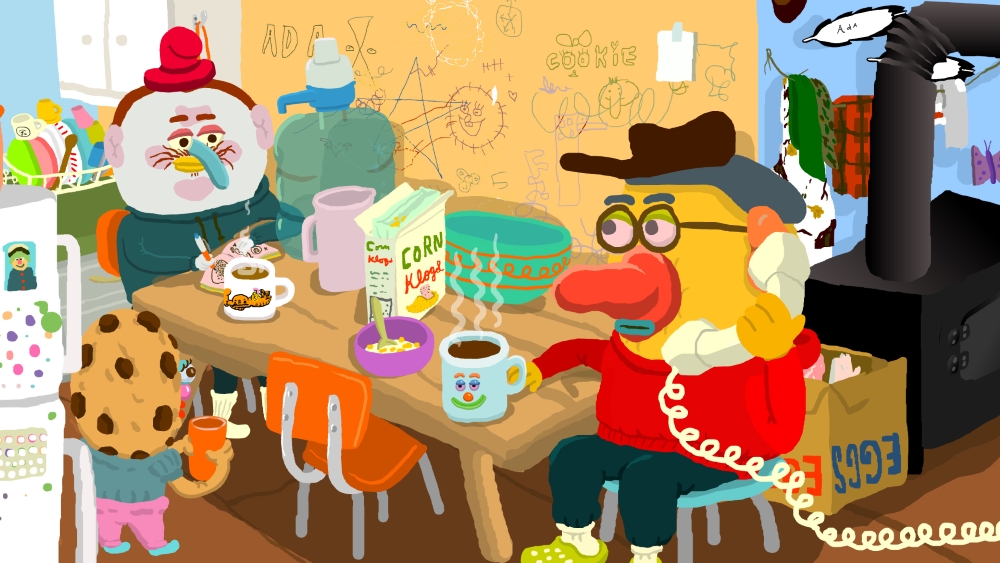
The project began with something simple: Pete telling stories. “Family conversations around the kitchen table,” he says over Zoom from Shamattawa, describing the everyday rhythm that first drew Seth to record their talks. What emerged from those early sessions was the texture of daily life itself: stories about family, work, seasons, jokes, frustrations — all the moments that aren’t usually depicted in representations of First Nations communities.
One story recounts the RCMP (Royal Canadian Mounted Police) reacting with what the brothers describe as typical hysteria to such ordinary events as a grandmother dressing a caribou for meat, with the officers assuming that a trail of blood-stained snow could only signal an active crime scene.


“There’s never a happy story about Shamattawa,” says Pete, explaining how most of the information that comes out of the region is generated by the RCMP. In contrast, he says, with his characteristic chuckle, “Where I come from, most of the people aren’t serious about anything.”
Traveling in Europe, Seth found himself using Pete’s stories to debunk common myths about Canada. “People would come up to us and be like, ‘Oh, you’re from Canada? Oh, Canada. Oh, the model citizen of the world. Oh, they’re so nice to their Native people. Oh, they’re so nice to the environment,’ saying all these things which were kind of not very true.”
For his next project, he thought, “I should definitely get Pete to tell his own stories.” A chance psychic consultation would later push him to contact producers Daniel Bekerman and Chris Yurkovich, setting the film’s long production process in motion.

Finding Structure in Chaos
Endless Cookie documents the difficulty of recording Pete’s stories in a tiny four-bedroom house crowded with eight kids, extended family and more than a dozen dogs constantly weaving in and out of the main room. Early on, Seth used grant money to fly north — trips he now freely admits were mainly “to go up and hang out with Pete and all the kids … build a teepee and whatever … and just be around and visit.”
The trips became too costly to sustain (“It’s really expensive to get up there,” he says), and only then did Seth realize he could simply mail a tape recorder north. Even that solution came with its own chaos: follow-up lines were constantly needed, Pete sometimes forgot to name who he was talking about and the household noise became an unavoidable part of the soundscape, including Ada Scriver — a family member who contributed to a song and assisted with ADR (automated dialog replacement) — trying to quiet the kids in the background. At one point, Pete and Ada discovered that all the files they’d uploaded were empty because the recorder hadn’t actually been rolling — a mishap that, like much of the production itself, ended up shaping the film’s loose, handmade rhythm.

In the end, the interruptions became part of the film’s structure rather than a problem to fix. Seth and Pete never managed a clean recording session, and the detours — kids calling out, dogs crossing the room, neighbors dropping by — kept overrunning whatever story Pete was trying to tell. Instead of cutting around the chaos, Seth embraced it, realizing that the constant drift was the point: Every conversation slid into another, every anecdote sparked someone else’s memory. The chain never quite returns to where it started, giving the film its looping, open-ended rhythm.
Seth Scriver’s first animated feature, Asphalt Watches (2013), which he directed with Shayne Ehman, follows the duo’s hitchhiking trek across Canada while dodging creepy ex-convicts and rapping with dogs, all set to a deep, bassy synth.

Music is just as central to Endless Cookie, which features an eclectic 28-song lineup consisting of esoteric old-school Canadian punk rock. Composer and sound designer Andrew Zukerman provides the film’s sonic backbone, but most of the soundtrack draws from Seth’s own circles — bands he’s played in, artists he’s collaborated with for years and musicians he counts as close friends.
“We are just kind of lucky that we know so many talented musicians who let us use their stuff,” Seth says, recalling how friends freely offered their entire catalogs for the film. “It’s also the beauty of spending nine years to make something. Eventually you run into someone that has some good tunes.”

“We’re working with family and that makes it a little more precious. If it wasn’t so personal, if it wasn’t all these people we love, I wouldn’t have spent so much time in this crazy way.”
— Director Seth Scriver
Family member Chris Scriver performed the traditional Native drumming and singing in the film, and Seth contributed cues himself, even whistling Chopin’s “Funeral March” for one sequence. The result feels as handmade as the animation: Songs slide in and out like memories, punctuating jokes or tangents with the same spontaneous energy that defines the film’s visual rhythm.

Shaping the Visuals
If the stories in Endless Cookie drift and loop in unexpected directions, the visuals dive straight into lo-fi psychedelia. Seth animated the film largely on his own over the course of eight years, drawing in a loose, hand-built style that leans into distortion and exaggeration. Early on, he worked using Flash 8 on an aging tablet before eventually upgrading to a Wacom Cintiq and Adobe Animate, but the tools mattered less than the approach: quick, associative drawings that slip between memory, metaphor and lived detail.
Character design followed the same logic. Seth sketched people through gestures, moods and sometimes objects that felt tied to who they were. The results can appear surreal on screen, yet when he showed early designs to relatives, they instantly recognized themselves and each other. That instinctive approach also extends to less obvious figures, including the film’s funder, Telefilm Canada, which Seth renders as a full-fledged character — a wry nod to the agency’s role in the project and a way of pulling the film’s funding realities into its visual universe.

A small team helped fill out the world — assistant animator Julian Gallese, additional animators Kristin (“Cookie”) and Simone (“Simminy”) Scriver, and graphic artist Diana Vandermeulen — but the production remained intentionally improvised. Sequences grew or contracted depending on the flow of the stories, and whole sections were reworked or cut, including roughly 30 minutes of finished animation that didn’t make the one-hour-and-37-minute final film.
“The movie was actually two hours long, fully animated, and we edited out half an hour,” Seth reveals, describing how editor Sydney Cowper trimmed meandering sequences to help tighten the narrative. “It was little distractions that maybe were too distracting, little vignettes,” he says. The idea of cutting so much material was “like a nightmare,” but once they watched the new cut, “It was like, ‘Oh, yeah, this is actually really good. Shorter is better.’”

“I don’t know if I would ever do that again,” he allows. “It was kind of crazy, but it’s nice that we did it this way. We’re working with family and that makes it a little more precious. If it wasn’t so personal, if it wasn’t all these people we love, I wouldn’t have spent so much time in this crazy way.”
Obscured Releasing opens Endless Cookie in select U.S. theaters on December 5. The film will be available on VOD to buy and rent on Dec. 16. Visit obscuredreleasing.com for details.